Maximum Heart Rate (MHR) Calculator
🎯 Target Heart Rate Calculator
Maximum Heart Rate (MHR) Calculator
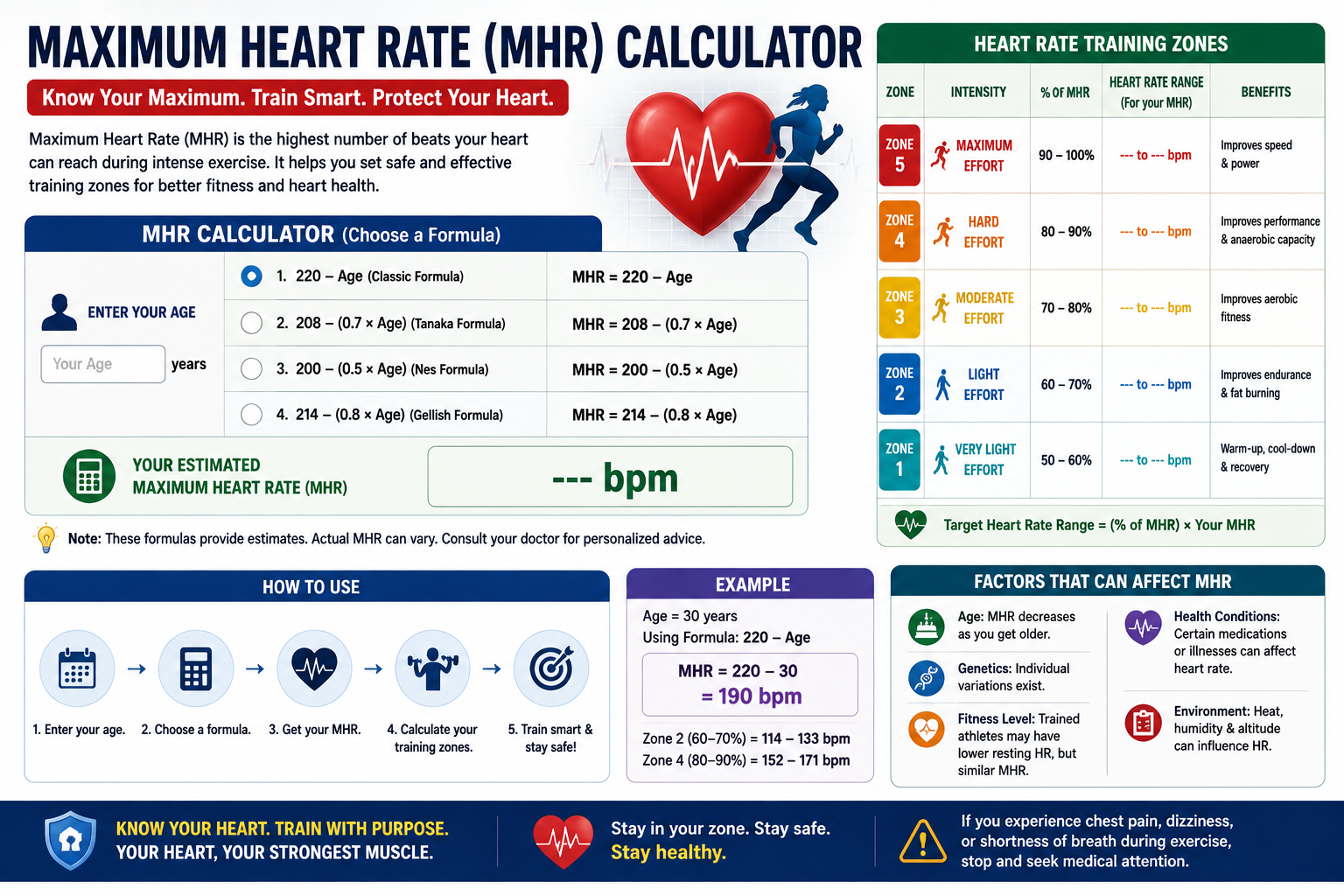
Maximum Heart Rate (MHR) is the highest number of times your heart is expected to beat per minute during maximal physical exertion. It is commonly used to estimate exercise intensity and establish training heart-rate zones. MHR is expressed in beats per minute (bpm) and varies mainly with age.
How to Calculate Maximum Heart Rate
A simple traditional formula is:
MHR = 220 − Age
For example, if you are 40 years old:
220 − 40 = 180 bpm
Therefore, the estimated maximum heart rate is approximately 180 bpm.
Another commonly used age-based equation is:
MHR = 208 − (0.7 × Age)
For a 40-year-old:
208 − (0.7 × 40) = 180 bpm
Both formulas provide an estimate rather than an exact measurement. Individual maximum heart rates can differ considerably because of genetics, fitness level, medications, cardiovascular health and other factors.
Maximum Heart Rate Calculator
| Age | Estimated MHR using 220 − age |
|---|---|
| 20 | 200 bpm |
| 25 | 195 bpm |
| 30 | 190 bpm |
| 35 | 185 bpm |
| 40 | 180 bpm |
| 45 | 175 bpm |
| 50 | 170 bpm |
| 55 | 165 bpm |
| 60 | 160 bpm |
| 65 | 155 bpm |
| 70 | 150 bpm |
Understanding Heart-Rate Training Zones
MHR can be used to estimate different exercise-intensity zones. A general five-zone model is:
| Zone | Approx. % of MHR | Typical intensity |
|---|---|---|
| Zone 1 | 50–60% | Very light |
| Zone 2 | 60–70% | Light to moderate |
| Zone 3 | 70–80% | Moderate |
| Zone 4 | 80–90% | Vigorous |
| Zone 5 | 90–100% | Very vigorous/maximal |
For example, a 40-year-old with an estimated MHR of 180 bpm would have an approximate 60–70% zone of 108–126 bpm.
These zones are useful for aerobic conditioning, endurance training and monitoring exercise intensity. However, they should be treated as estimates rather than rigid targets.
Why Maximum Heart Rate Matters
Knowing your estimated MHR can help you:
- Monitor exercise intensity
- Avoid exercising unnecessarily hard
- Structure aerobic training
- Track changes in fitness over time
- Establish personalized training zones
- Understand heart-rate responses during exercise
For recreational exercise, moderate-intensity activity is generally sufficient to provide substantial cardiovascular benefits. People beginning an exercise program should increase intensity gradually rather than attempting to reach their predicted maximum heart rate.
MHR Is Not the Same as Resting Heart Rate
Maximum heart rate and resting heart rate measure different aspects of cardiovascular function.
Resting heart rate (RHR) is the number of heartbeats per minute while you are relaxed and resting. Maximum heart rate represents the highest expected rate during maximal exertion.
A lower resting heart rate in a healthy, physically trained individual can reflect improved cardiovascular efficiency, but resting heart rate should always be interpreted in context.
Limitations of the MHR Formula
Age-based formulas have substantial individual variability. Two people of the same age may have different actual maximum heart rates. Therefore, reaching a predicted MHR does not necessarily mean that a person has reached their true physiological maximum.
Certain medications can also alter heart-rate response. Beta-blockers, for example, may prevent the heart rate from rising normally during exercise. In such situations, calculated heart-rate zones may be inappropriate, and exercise intensity may need to be guided by symptoms, perceived exertion or a clinician-directed exercise prescription.
When to Seek Medical Advice
People with known heart disease, unexplained chest pain, significant breathlessness, fainting, abnormal heart rhythms or other cardiovascular conditions should obtain appropriate medical advice before undertaking vigorous exercise.
During exercise, chest pressure or pain, severe shortness of breath, fainting, marked dizziness or a sudden irregular heartbeat should not be ignored.
Key Takeaway
The simplest Maximum Heart Rate calculation is 220 − age, while 208 − (0.7 × age) is another widely used estimate. These equations are useful for creating approximate exercise zones, but they cannot determine an individual's exact maximum heart rate. For personalized cardiovascular training—particularly in people with heart disease or those taking heart-rate-altering medications—professional assessment is preferable.
MHR is a guide, not a diagnosis or a substitute for individualized medical advice.
How to estimate your maximum heart rate
The most common age-based formulas provide an estimate, but no single formula is universally accurate for everyone.
Common Formulas
- Fox formula: MHR = 220 - Age.
- This is the simplest and most well-known formula, but it is also the least accurate. It may be off by 10 to 12 beats per minute and becomes less reliable with increasing age.
- Tanaka formula: MHR = 208 - (0.7 × Age).
- This formula is a more modern and accurate alternative for a general population, particularly for people over 40.
- Gulati formula (for women only): MHR = 206 - (0.88 × Age).
- Developed by Martha Gulati and her colleagues, this formula provides a more accurate estimate for women, as other formulas were historically based on data from men.
- Nes formula (for active people): MHR = 211 - (0.64 × Age).
- Based on data from the HUNT Fitness Study, this equation is considered more accurate than the traditional 220-age formula, especially for healthy and active adults.
Most accurate way to determine MHR
For the most precise measurement, an exercise test supervised by a cardiologist or exercise physiologist is recommended. The test involves progressively increasing the intensity of exercise until your heart rate reaches its peak.
How to use maximum heart rate for exercise
Once you have an estimate of your MHR, you can find your target heart rate zones for different exercise intensities:
- Moderate intensity: 50%–70% of your MHR.
- Vigorous intensity: 70%–85% of your MHR.
Factors that influence maximum heart rate
While age is the most significant factor, other variables also play a role and contribute to individual differences:
- Genetics: Genetic predispositions can influence your cardiovascular health and heart rate response to exercise.
- Altitude: Exercising at higher altitudes can lower your MHR.
- Medication: Certain medications, especially beta-blockers for high blood pressure, can lower your heart rate.
- Size: Smaller individuals tend to have higher maximum heart rates, which is one reason women often have a higher MHR than men.
- Fitness level: A higher fitness level can lower your resting heart rate, but it does not increase your MHR. In fact, training can sometimes cause a slight decrease in MHR as the heart becomes more efficient.

Medicine Question Bank