D-dimer test
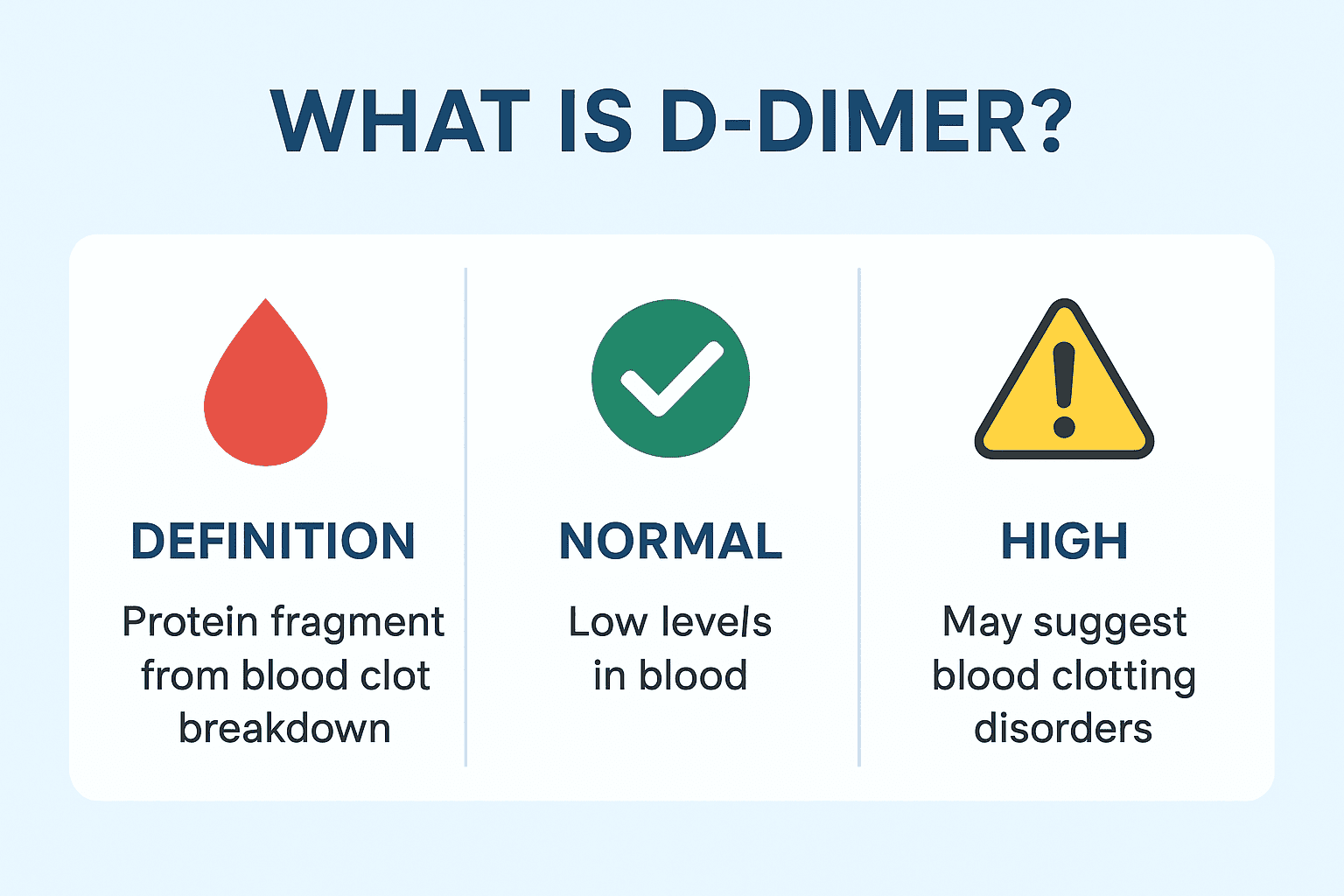
An elevated D-dimer indicates increased clot breakdown in the body and is a marker for potential blood clotting disorders like deep vein thrombosis (DVT) or pulmonary embolism (PE). However, elevated levels can also result from other conditions, including pregnancy, recent surgery, infection, malignancy (cancer), liver disease, and trauma, which cause increased clotting and fibrinolysis. A positive D-dimer requires further tests to pinpoint the cause and confirm or rule out a blood clot.
What is D-dimer?
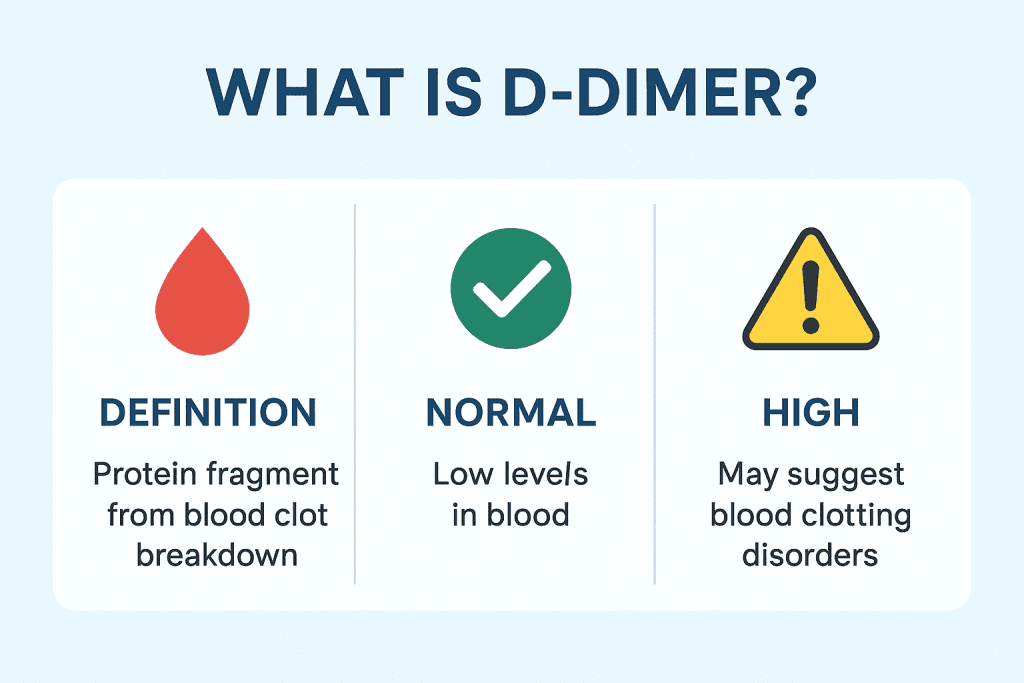
D-dimer is a protein fragment created when a blood clot breaks down. A D-dimer test measures these fragments in the blood.
What does an elevated D-dimer mean?
A high D-dimer level means your body is producing more D-dimer, which can be a sign that you are forming blood clots.
When is a D-dimer test used?
A D-dimer test is used to help:
- Diagnose or rule out: blood clots, such as DVT and PE.
- Evaluate: the risk of a blood clotting condition, especially in emergency settings.
What causes an elevated D-dimer level?
Besides clotting disorders, several other factors can cause an elevated D-dimer:
- Pregnancy: A normal condition with increased clotting.
- Surgery or trauma: Major injuries or recent operations increase clotting.
- Infections and sepsis: These can trigger the body’s clotting system.
- Malignancy (cancer): Certain cancers are associated with increased clotting.
- Liver disease: The liver’s role in D-dimer clearance is affected.
- Heart disease: Conditions affecting the heart can lead to high levels.
- Advanced age: D-dimer levels naturally rise with age.
- Disseminated Intravascular Coagulation (DIC): A severe condition where many small clots form throughout the blood vessels.
What to do with an elevated D-dimer?
An elevated D-dimer does not confirm a blood clot. Your doctor will likely order additional tests to determine the cause and assess if you have a life-threatening clot.
D-Dimer test is a blood test used mainly to help rule out or confirm abnormal blood clotting conditions.
🔹 What is D-Dimer?
- D-dimer is a protein fragment produced when a blood clot dissolves in the body.
- Normally, levels are very low. Elevated levels suggest the body is forming and breaking down clots more than usual.
🔹 When is it done?
Doctors order it when they suspect:
- Deep Vein Thrombosis (DVT) – clot in the leg veins.
- Pulmonary Embolism (PE) – clot in the lungs.
- Disseminated Intravascular Coagulation (DIC) – widespread clotting in the body.
- As part of tests for stroke or heart attack in some cases.
- Sometimes used in COVID-19 patients to assess clotting risks.
🔹 Normal Values
- Usually < 500 ng/mL (varies slightly by lab method).
- Negative (normal) D-Dimer: Clotting problem is very unlikely.
- Positive (high) D-Dimer: Suggests clotting, but not specific (could be high in many other conditions like infection, liver disease, pregnancy, surgery, trauma, or cancer).
🔹 Limitations
- A positive result does not confirm a clot – it only means more tests (like ultrasound, CT scan) are needed.
- More useful for ruling out clots than confirming them.
30 FAQs on D-Dimer Test
General Information
- What is the D-dimer test?
It is a blood test that measures fragments of protein released when blood clots dissolve. - Why is it called D-dimer?
Because the test detects two cross-linked D fragments of fibrin (a protein in clots). - What does the D-dimer test check for?
It helps detect abnormal clot formation and breakdown in the body. - Is the D-dimer test specific for blood clots?
No, it only shows clot activity but does not confirm where or why the clot formed. - Is D-dimer normally present in blood?
Yes, but at very low levels in healthy people.
Indications
- When is the test usually ordered?
If a doctor suspects deep vein thrombosis (DVT), pulmonary embolism (PE), or disseminated intravascular coagulation (DIC). - Can it be used in COVID-19?
Yes, it is often measured to check clotting risk in COVID-19 patients. - Can it help detect stroke or heart attack?
Sometimes, but it is not the primary test. - Is it used for routine check-ups?
No, only when clotting disorders are suspected. - Can it be used to monitor treatment?
Yes, sometimes it helps check response to anticoagulant (blood thinner) therapy.
Test Procedure
- How is the test performed?
A blood sample is taken from a vein in your arm. - Do I need fasting before the test?
No, fasting is not required. - How long does it take to get results?
Usually within a few hours to a day, depending on the lab. - Is it painful?
Only a mild prick during blood draw. - Is it safe?
Yes, it is a simple blood test with minimal risk.
Results & Interpretation
- What is a normal D-dimer level?
Typically less than 500 ng/mL (may vary by lab). - What does a negative D-dimer mean?
It usually rules out a serious clotting disorder. - What does a positive D-dimer mean?
It indicates abnormal clotting activity, but more tests are needed. - Can D-dimer alone diagnose a clot?
No, imaging (like ultrasound or CT scan) is needed for confirmation. - Does age affect D-dimer levels?
Yes, levels tend to rise with age, so age-adjusted cutoffs are sometimes used.
False Results
- Can D-dimer be high without a clot?
Yes, in conditions like infection, liver disease, pregnancy, trauma, or recent surgery. - Can D-dimer be low even if there is a clot?
Rarely, yes – especially in small clots or if the test is done too early. - What causes false positives?
Inflammation, cancer, pregnancy, recent surgery, or aging. - What causes false negatives?
Small clots, delayed testing, or very early stages of clot formation. - Can medicines affect D-dimer levels?
Yes, anticoagulants (blood thinners) may lower levels.
Special Cases
- Is D-dimer high during pregnancy?
Yes, naturally higher due to body changes, so interpretation is different. - Can children take this test?
Yes, but clotting disorders in children are rare. - Does exercise affect D-dimer?
Intense exercise can sometimes raise levels temporarily. - Can liver disease affect results?
Yes, because the liver processes clotting proteins, D-dimer may rise in liver problems. - Is D-dimer useful after surgery?
It may be elevated for days after surgery, so not always reliable immediately post-operation.