Prioritize Quality Sleep
😴 Prioritize Quality Sleep
Good sleep is as important as diet and exercise. Adults should aim for 7–9 hours of quality sleep every night.
🌙 1. Maintain a Fixed Sleep Schedule
- Sleep and wake up at the same time daily (even weekends)
- Align with your natural body clock (circadian rhythm)
📵 2. Reduce Screen Exposure Before Bed
- Avoid mobile/TV 60 minutes before sleep
- Blue light suppresses melatonin (sleep hormone)
- Use night mode if needed
🍽️ 3. Avoid Heavy Late-Night Meals
- Finish dinner 2–3 hours before bedtime
- Avoid caffeine after 4–5 PM
- Limit spicy & oily food at night
🛏️ 4. Create a Sleep-Friendly Environment
- Dark, quiet, cool room
- Comfortable mattress & pillow
- Use bed only for sleep (avoid working in bed)
🧘 5. Relax Before Sleeping
- Try deep breathing (4-7-8 method)
- Light stretching
- Meditation or prayer
- Reading a physical book
☀️ 6. Get Morning Sunlight
- 10–20 minutes of early sunlight helps reset sleep cycle
- Supports Vitamin D production
🚶 7. Exercise Regularly
- 30 minutes daily movement
- Avoid intense workouts right before bed
⚠️ Seek Medical Help If:
- Loud snoring or choking at night
- Persistent insomnia (>2 weeks)
- Daytime sleepiness
- Morning headaches
🧠 Science of Sleep Cycles
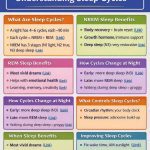
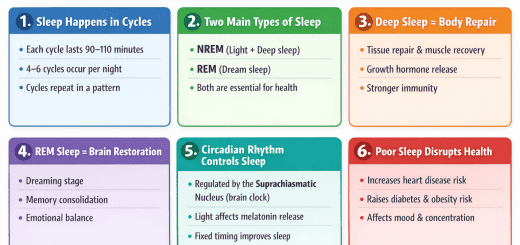
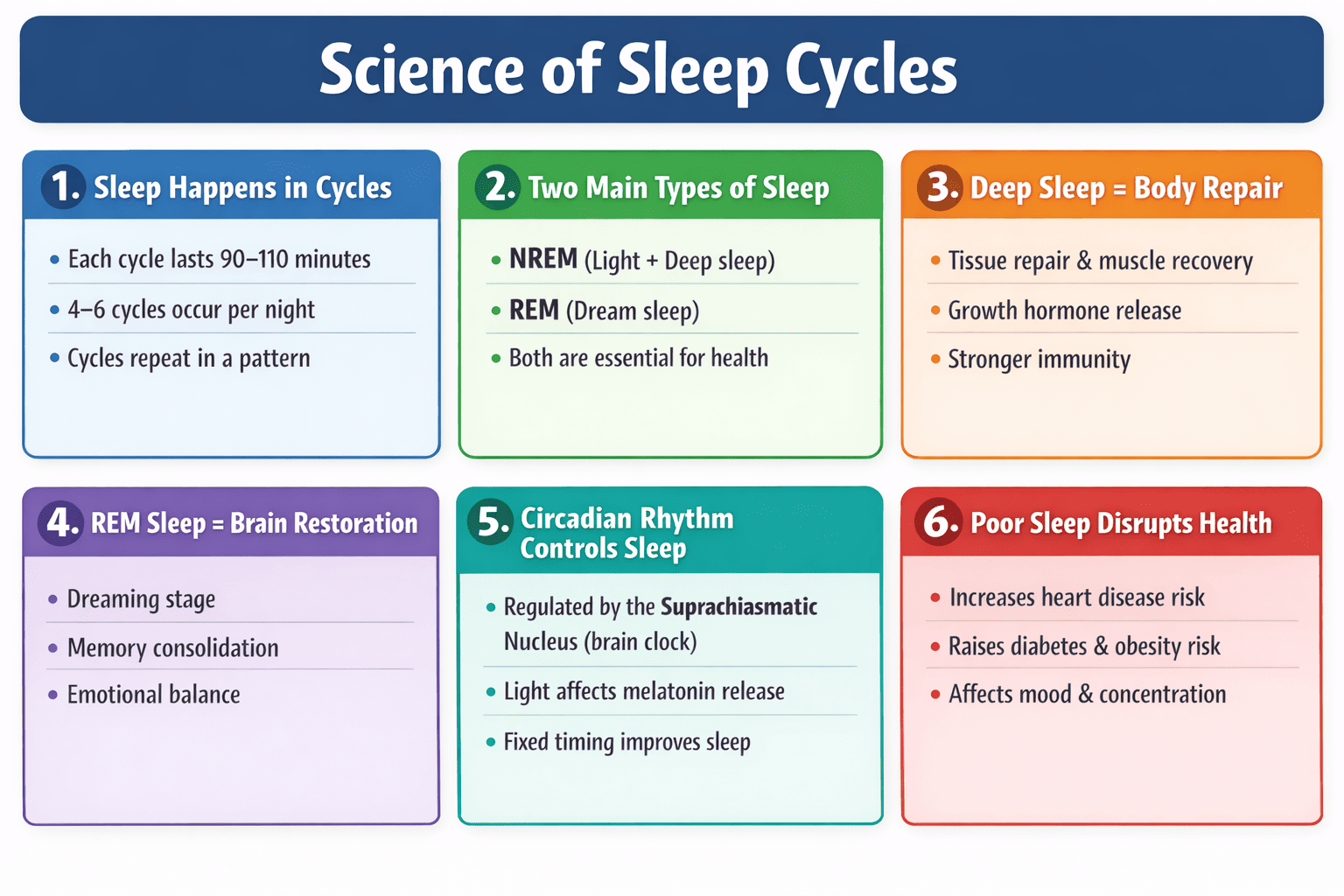
Sleep is not a single uniform state. It moves through repeating cycles, each lasting about 90–110 minutes, and most adults experience 4–6 cycles per night.
Sleep has two main types:
- NREM (Non-Rapid Eye Movement)
- REM (Rapid Eye Movement)
These are regulated by the brain’s master clock — the Suprachiasmatic nucleus — which controls your circadian rhythm.
🌙 The 4 Stages of Sleep
1️⃣ NREM Stage 1 (Light Sleep)
- Transition from wakefulness to sleep
- Lasts 1–7 minutes
- Muscles relax, slow eye movements
- Easy to wake up
🧠 Brain waves slow from alpha to theta waves.
2️⃣ NREM Stage 2 (True Sleep)
- Makes up ~50% of total sleep
- Body temperature drops
- Heart rate slows
- Brain produces “sleep spindles” (memory processing)
📌 Important for learning and memory consolidation.
3️⃣ NREM Stage 3 (Deep Sleep / Slow-Wave Sleep)
- Hardest stage to wake from
- Body repairs tissues
- Growth hormone released
- Immune system strengthens
💪 Critical for physical recovery and immunity.
4️⃣ REM Sleep (Dream Sleep)
- First REM occurs ~90 minutes after falling asleep
- Brain becomes highly active
- Most vivid dreaming happens
- Memory & emotional regulation improve
🧠 Brain activity during REM resembles wakefulness.
🔁 How Sleep Cycles Work Overnight
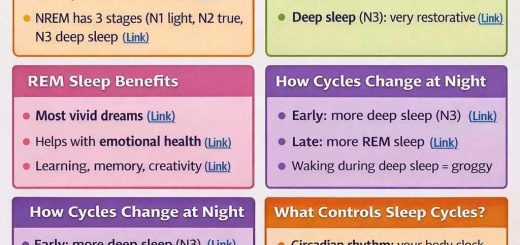
- Early night → More deep sleep (Stage 3)
- Late night → More REM sleep
- REM periods get longer toward morning
This is why:
- Sleeping late but waking early → Misses REM
- Sleeping too little → Reduces deep sleep
⏰ Role of Circadian Rhythm
Your internal body clock is influenced by:
- Light exposure
- Hormones (melatonin rises at night)
- Regular sleep timing
Disruption (shift work, late-night screen use) can disturb cycles.
🧬 Why Sleep Cycles Matter
Good sleep supports:
- ❤️ Heart health
- 🧠 Brain performance
- 🛡️ Immunity
- ⚖️ Hormone balance
- ⚡ Energy & metabolism
Poor sleep increases risk of:
- Obesity
- Diabetes
- Heart disease
- Depression
⚠️ Signs Your Sleep Cycles Are Disturbed
- Waking tired despite 7–8 hours
- Frequent night awakenings
- Loud snoring (possible sleep apnea)
- Daytime sleepiness
🧠 Basics of Sleep Cycles (1–20)
- What is a sleep cycle?
A repeating pattern of NREM and REM sleep lasting 90–110 minutes. - How many sleep cycles occur per night?
4–6 cycles in healthy adults. - What are the two main types of sleep?
NREM (Non-REM) and REM sleep. - What controls sleep cycles?
The brain’s circadian clock in the Suprachiasmatic nucleus. - What is NREM sleep?
Non-dream sleep focused on physical restoration. - What is REM sleep?
Dream sleep linked to brain activity and memory. - How long is one sleep cycle?
About 90–110 minutes. - Which stage comes first?
NREM Stage 1. - When does REM first occur?
About 90 minutes after falling asleep. - Do cycles repeat the same way all night?
No, REM increases toward morning. - What is light sleep?
NREM Stages 1 and 2. - What is deep sleep?
NREM Stage 3 (slow-wave sleep). - Which stage is hardest to wake from?
Deep sleep (Stage 3). - Where does dreaming mostly occur?
REM sleep. - Is REM sleep active?
Yes, brain activity resembles wakefulness. - Do babies have more REM sleep?
Yes, much more than adults. - Does aging affect sleep cycles?
Yes, deep sleep decreases with age. - Is 8 hours necessary for everyone?
Most adults need 7–9 hours. - What is sleep latency?
Time taken to fall asleep. - What is sleep efficiency?
Percentage of time in bed actually asleep.
🌙 NREM & Deep Sleep (21–40)
- What happens in Stage 1?
Transition to sleep. - What happens in Stage 2?
Memory processing and body slowing. - What happens in Stage 3?
Tissue repair and hormone release. - Why is deep sleep important?
For immunity and recovery. - Does exercise increase deep sleep?
Yes, regular exercise improves it. - Does alcohol affect deep sleep?
Yes, it reduces sleep quality. - Is snoring linked to deep sleep problems?
Often yes, especially in sleep apnea. - Does growth hormone release during sleep?
Yes, mainly during deep sleep. - Is deep sleep longer early in the night?
Yes. - Can stress reduce deep sleep?
Yes. - Is deep sleep important for athletes?
Very important for muscle repair. - Does pain affect deep sleep?
Yes. - Does caffeine affect deep sleep?
Yes, if taken late. - Can naps replace deep sleep?
Not fully. - What brain waves dominate deep sleep?
Delta waves. - Does aging reduce delta waves?
Yes. - Can insomnia reduce deep sleep?
Yes. - Does screen exposure affect NREM?
Yes, by delaying sleep. - Can meditation improve NREM sleep?
Yes. - Is deep sleep linked to immunity?
Strongly linked.
🌈 REM Sleep (41–60)
- Why do we dream?
Brain processing emotions & memory. - Is REM important for learning?
Yes. - Does REM increase toward morning?
Yes. - Can lack of REM affect mood?
Yes. - Does REM paralyze muscles?
Yes (normal protective mechanism). - Is REM linked to depression?
Disturbed REM is common in depression. - Can nightmares occur in REM?
Yes. - Is REM shorter in elderly?
Slightly reduced. - Does alcohol suppress REM?
Yes. - Can REM rebound occur?
Yes, after sleep deprivation. - Does REM help creativity?
Yes. - Is REM sleep lighter than deep sleep?
Yes. - Do antidepressants affect REM?
Many reduce REM. - Can REM behavior disorder occur?
Yes, loss of muscle paralysis. - Is REM present in naps?
Only if nap is long enough. - Does sleep deprivation reduce REM first?
Deep sleep is reduced first; REM rebounds later. - Are vivid dreams normal?
Yes. - Is REM essential daily?
Yes. - Can anxiety disturb REM?
Yes. - Is REM important for emotional control?
Yes.
⏰ Circadian Rhythm (61–75)
- What is circadian rhythm?
24-hour internal body clock. - What regulates it?
The Suprachiasmatic nucleus. - What hormone controls sleep timing?
Melatonin. - When is melatonin released?
In darkness. - Does sunlight affect sleep cycles?
Yes. - Can shift work disturb cycles?
Yes. - What is jet lag?
Circadian misalignment. - Does late-night phone use delay sleep?
Yes. - Can fixed timing improve sleep?
Yes. - Does exercise reset circadian rhythm?
Morning exercise helps. - Is late-night eating harmful to sleep?
Yes. - Do teenagers sleep later naturally?
Yes. - Does aging shift circadian rhythm earlier?
Yes. - Can insomnia be circadian-related?
Yes. - Is circadian rhythm genetic?
Partly.
⚠️ Sleep Disorders & Health (76–100)
- What is insomnia?
Difficulty sleeping. - What is sleep apnea?
Breathing pauses during sleep. - Is loud snoring normal?
Not always. - Can poor sleep increase heart disease risk?
Yes. - Does sleep affect diabetes risk?
Yes. - Is obesity linked to poor sleep?
Yes. - Can sleep loss weaken immunity?
Yes. - Does sleep affect blood pressure?
Yes. - Can poor sleep affect memory?
Yes. - Does lack of sleep increase accidents?
Yes. - Is sleep important for children’s growth?
Very important. - Can depression affect sleep cycles?
Yes. - Does anxiety disturb sleep?
Yes. - Can thyroid disorders affect sleep?
Yes. - Does screen addiction affect sleep?
Yes. - Is 5 hours of sleep enough?
Not for most adults. - Can naps help?
Short naps (20–30 mins) help. - Is oversleeping harmful?
Can indicate health issues. - Does sleep affect hormones?
Yes. - Is consistent sleep timing important?
Very important. - Can sleep tracking devices be accurate?
Approximate only. - Does meditation improve sleep cycles?
Yes. - Is deep sleep more important than REM?
Both are essential. - Can lifestyle changes fix sleep cycles?
Often yes. - What is the best way to improve sleep quality?
Fixed schedule + dark room + exercise + limited screens.